Friday, September 29, 2006

Whom do Men Say I Am?

And Jesus said unto his disciples, "Whom do men say that I am?" (Matt. 16:13, Mark 8:27)
And His disciples answered unto Him, "Master, thou art the supreme eschatological manifestation of omnipotent ecclesiastical authority, the absolute, divine, sacerdotal monarch."
And Jesus said, "What?"

Wednesday, September 27, 2006

Brokenness, a Neccessary Component of our Faith

To be broken and have a contrite heart is virtually lost on todays evangelicals.

We don't weep over sin.

We don't confess our sin - to man or God.

We don't even acknowledge it as real . . .

We probably wouldn't even fall to the ground and weep over the glories of the cross as Jonathan Edwards did (when he fell off his horse overhelemed with what Christ did).

Check out this excellant article on brokeness from
Cerulean Sanctum:
The Battle for Brokenness

Monday, September 25, 2006

Calvinsim and Our Current Evangelical Landscape

Here is an article that is by Christianity Today about Reformed Theology (specifically calvinism) and it growing influence in the church: Young, Restless, Reformed

I believe it will continue to increase more as young people are seeking God and looking for serious answers to their questions and are desirous of a serious relationship with God; and right now, serious, deep, answers are found among primarly calvinistic teachers.

Also check out the follwing. I found this at Justin Taylor's BLOG,
Between Two Worlds.

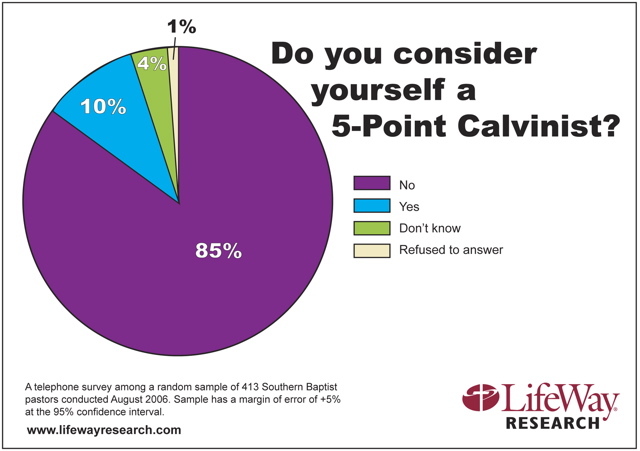
LifeWay Research recently looked into how many pastors in the Southern Baptist Convention are Calvinists.

The above chart reflects some of the results.

Tom Ascol on his Founders Ministries BLOG has some reflections on this, under the section: Lifeway: 10% of SBC pastors are 5 Point Calvinists.

For more on this, see the follwing article: LifeWay Research Prepares Initial Studies; Calvinism Among Southern Baptists Is First Study; by Chris Turner.

Saturday, September 23, 2006

John Piper is BAD!

John Piper is BAD!

Hear him confess (.MP3).

I found this over at Eric Zeller's blog: foolishblog

Tuesday, September 19, 2006

A Comparison of 5 Views on Theology (part 3)

The following series is meant for fun only. As the different views are explained, they will be caricatures only. As I express my view (very po-mo of me), it is a way for me to interact with all the different views out there. I invite your feedback on either my views or the traditional views.

My view will be identified as the Theology of Hope

God’s Purpose in History
Covenant Theology:

God’s main purpose is His own glory and Christ is the glory of God and we (the elect of God – from both the OT and NT) are in Christ.

Historic Dispensationalism:
God’s main purpose in history is national, physical Israel. God has two separate peoples, Israel and the church – with two separate plans for two distinct peoples.

Progressive Dispensationalism:
Same as CT
New Covenant Theology:
Same as CT

The Theology of Hope:
Would agree with CT and would add that God’s goal (or eternal purpose; aka misseo Dei) for creation is a renewed heaven and earth, on which all those for whom Christ died will dwell. Here they will enjoy the presence of the Triune God for all eternity.

A Comparison of 5 Views on Theology (part 2)

The following series is meant for fun only. As the different views are explained, they will be caricatures only. As I express my view (very po-mo of me), it is a way for me to interact with all the different views out there. I invite your feedback on either my views or the traditional views.

My view will be identified as the Theology of Hope

View of History
Covenant Theology:

Optimistic: God is extending His kingdom.

Historic Dispensationalism:
Pessimistic: the Last Days are marked by increasingly worse wickedness in the world and by apostasy in the church.

Progressive Dispensationalism:

Similar to CT

New Covenant Theology:
NCT is divided over this subject. Most agree with CT.

The Theology of Hope:
Same as CT

Saturday, September 16, 2006

Biblical Manhood - a lost pursuit?

Check out the following three posts from, Cerulean Sanctum:

The Church’s Missing Men
Another Look at the Church’s Missing Men
The Humble Warrior

I came across these a few days ago.

They are by far some of the best articles / posts I have read on the subject in quite some time.

On-line Quiz: What's your theological worldview?

Check this out: thout this on-line quiz: What's your theological worldview?

I took the quiz and here are my results:

You are a Reformed Evangelical.

You take the Bible very seriously because it is God's Word. You most likely hold to TULIP and are sceptical about the possibilities of universal atonement or resistible grace. The most important thing the Church can do is make sure people hear how they can go to heaven when they die.
Reformed Evangelical: 75%
Evangelical Holiness/Wesleyan: 68%
Neo orthodox: 64%
Fundamentalist: 61%
Charismatic/Pentecostal: 57%
Emergent/Postmodern: 54%
Classical Liberal: 36%
Roman Catholic: 32%
Modern Liberal: 11%

Created by: Quiz Farm
More quizes by svensvensven's tests

On-line Quiz: Are You a Heretic?

Check this out: thout this on-line quiz: Are You a Heretic?

I took the quiz and here are my results:

You are Chalcedon compliant.

Congratulations, you're not a heretic. You believe that Jesus is truly God and truly man and like us in every respect, apart from sin. Officially approved in 451.
Chalcedon compliant: 100%
Nestorianism: 42%
Modalism: 33%
Monophysitism: 33%
Monarchianism: 33%
Socinianism: 8%
Pelagianism: 8%
Apollanarian: 0%
Adoptionist: 0%
Arianism: 0%
Gnosticism: 0%
Albigensianism: 0%
Donatism: 0%
Docetism: 0%


Created by: Quiz Farm

More quizes by svensvensven's tests

On-line Quiz: Which Theologian are you?

Check this out: thout this on-line quiz: “Which theologian are you?”

I took the quiz and here are my results:


You scored as Anselm.
You scored as Anselm. Anselm is the outstanding theologian of the medieval period.He sees man's primary problem as having failed to render unto God what we owe him, so God becomes man in Christ and gives God what he is due. You should read 'Cur Deus Homo?'

Anselm: 87%
Martin Luther: 87%
Karl Barth: 80%
John Calvin: 67%
Jonathan Edwards: 67%
Friedrich Schleiermacher: 67%
Paul Tillich: 53%
Charles Finney: 33%
J.Moltmann: 27%
Augustine: 27%

Created by: Quiz Farm
More quizes by svensvensven's tests

Wednesday, September 13, 2006

A Comparison of 5 Views on Theology (part 1)

The following series is meant for fun only. As the different views are explained, they will be caricatures only. The expression of my view (very po-mo of me) is a way for me to interact with all the different views out there.
We will discuss different topics and their correlation to one another. I invite your feedback on either my views or the traditional views.

My view will be identified as the Theology of Hope

Pattern of History
Covenant Theology:
God’s program in history is mainly through related covenants:
1. The Covenant of Redemption involves the Trinity, and does not directly include human beings.
2. The Covenant of Works, instituted in the Garden of Eden, was the promise that perfect obedience would be rewarded with eternal life. This is the pre-fall relationship, God had with man.
3. The Covenant of Grace structures God’s post-fall relationship to mankind.

Historic Dispensationalism:
God’s program (purpose) in history is mainly through separate dispensations (stages or economies) – usually seven:
1) Innocence (before the Fall); Genesis 1-3
2) Conscience (Adam to Noah); Genesis 6-8
3) Human Government (Noah to Abraham); Genesis 11
4) Promise (Abraham to Moses); Gen 12 – Exodus 20
5) Law (Moses to Christ – His First Coming); Exodus 20 – Acts 1, Pentecost
6) Grace (Pentecost to the rapture); Acts 1ff
7) The Millennium or Kingdom (Christ’s Second Coming to the end of the 1,000 yrs.).

Progressive Dispensationalism:
God’s program is history is the progressive relationship of the successive dispensations to one another:
1. Patriarchal (Adam to Mt. Sinai)
2. Mosaic (Mt. Sinai to ascension of Messiah)
3. Ecclesial (Church – Ascension to Second Coming of Christ)
4. Zionic (Subdivided into 2 phases – Part 1: Millennium, Part: 2 Eternal State.)

New Covenant Theology:
God’s program in history is through related covenants, but culminating in the new covenant that fulfills the others because they were all realized in Christ.

The Theology of Hope:
Agrees with NCT; would add that redemption “holistically” is revealed in the following (not linear) :
1. Promise (Gen. 3:15; 17:1-8; II Sam. 7:4-17; Gal.3:16)
2. Law / Administration (Exodus 19:1-9a; cf. Gal. 3:17, 23, 25)
3. Fulfillment – consisting of both Inauguration and Consummation (Gal. 3:23, 25)

Tuesday, September 12, 2006

Where the Streets have No Name

Have you ever heard that the song, Where the Streets have No Name is about the Kingdom of Heaven?

In the first verse of the song Bono states “I want to tear down the walls that hold me inside.” He longs to leave his earthly body.
When he states “when I go there, I go there with you, it’s all I can do,” he is talking to God or Jesus (or perhaps other gods, from other religions).

In longing for heaven he states, “I want to feel sunlight on my face, I see the dust clouds disappear without a trace. I want to take shelter from the poison rain where the streets have no name.”

On the Live in Boston DVD, Bono introduces the song from the more spiritual perspective, saying to the audience, “we’re going to give back to God for the blessings he poured out at the time of the salvation.”

LYRICS:
I wanna run
I want to hide
I wanna tear down the walls
That hold me inside
I wanna reach out
And touch the flame
Where the streets have no name

I wanna feel sunlight on my face
I see the dust cloud disappear without a trace
I wanna take shelter from the poison rain
Where the streets have no name

Where the streets have no name
We're still building
Then burning down love,
Burning down love
And when I go there
I go there with youIt's all
I can doThe city's a flood
And our love turns to rust
We're beaten and blown by the wind
Trampled in dust
I'll show you a place
High on a desert plain
Where the streets have no name
We're still building
Then burning down love,
Burning down love
And when I go there
I go there with you
It's all I can do
Our love turns to rust
We're beaten and blown by the wind
Blown by the wind
Oh yes, in dust
See our love turn to rust
And we're beaten and blown by the wind
Blown by the wind
Oh, when I go there
I go there with you
It's all I can do

Friday, September 08, 2006

New Covenant Theonomy? (part 2)

Ok, in my previous post: New Covenant Theonomy? I laid the foundation for the eternal, moral ethic (will, law) being the foundation for the law of Christ. In this post I plan to explain why the law of Christ; a rule in righteousness; is a theocratic rule.
The reason I say that I am a theonomist is because Christ’s Rule is by "Law."
Under this New Covenant (initial-stage of the prophetic kingdom [now and not yet theology] ), God’s Law has not been merely given to us as a standard, but has been written on our hearts by the Holy Spirit (Jer. 31:33; Ezekiel 36:27; cf. Rom. 7:6; 8:14).
This enshrinement of the eternal, moral Law written on the heart is different from the Natural Law revealed in creation (cf. Rom. 2:14-15). It is not that He is knowable – as in the Old Covenant (i.e. Rom. 1:20; 2:14-15), but that we know Him (cf. Jer. 31:34) – it is grace efficaciously applied to a sinner, transforming a God-hater (Rom. 1:30) into an incurable God-lover.
Therefore, in “this Age;” Christ’s righteousness has been imputed to us; by the Spirit, enabling us to obey the words of Christ – because we now have a new heart to do so – a Spirit empowered heart (cf. Ezekiel 36:26-27) i.e. walking in the Spirit (Gal. 5:16, 25). This may also be known as the “ethics of the kingdom” partially realized now (aka: law-fulfilling free people).
However, Christ’s (Davidic) kingdom (as expressed in both promise and law; aka the everlasting covenant) is realized in the new heavens and new earth (the Age to come).
Only then will Christ receive His just rewards (for His life and sacrifice) as king of the earth.
I would not consider this statement a capitulation to either CT or Reconstructionism. I would embrace much of what NCT believes on the fulfillment and the end of the Mosaic Covenant (a temporary covenant, which of course revealed something far greater).
Would love to hear from you . . .

God's Law

Does “God’s Law” transcend its covenantal expressions (i.e. Mosaic, or Law of Christ)?
I am inclined to think so. Now I’ don’t try to get the “ten commandments” into the NC as eternal expression of the moral ethic (will, law), as the CT tradition does; but I do see an eternal, moral ethic (will, law) that transcends the revelation of covenants.
It is true that knowledge of God’s moral demands written on man’s heart (Rom. 2:14-5; i.e. law of nature / conscious) and the law expressed at Sinai are two separate laws. Yet they intersect at many points. So it would seem that there is some sort eternal standard that binds them together. Surely we can’t claim that these “different laws” were formed in a vacuum, with no moral foundation (i.e. God).
It is this moral foundation, that I believe, serves as the basis for the revelation / law of nature (Romans 2:14-15; cf. 1:19, 20, 32, i.e. creation ethic), the Law of Moses and the Law of Christ.
I believe this is true because God Himself is the standard for morality, and since sin is an infraction of God’s character, not necessarily and infraction of the covenant in place at the time of the infraction.
Let me know your thoughts as I wrestle with this myself
The following link expresses the eternal, moral ethic as I have come to understand it: Three Enshrinements of God’s Eternal Moral Ethic (Law / Will)

Monday, September 04, 2006

Covenantal Metanarrative

Rather than get hung up whether the hermeneutic of Dispensationalism or Covenant Theology is the thrust of your system, why not use a more organic, simpler approach?

Such as covenantal metanarrative or progressive covenantalism. Here is my rational:

God has chosen also to reveal Himself and the Kingdom of His Son by way of Covenants.They are of significance in the drama of redemption. Or to put it anther way, God’s eternal purpose as revealed in creation, and in the culminating covenants, which find there fulfillment in the coming of Jesus – God’s Kingdom. This is the primary way God has chosen to reveal Himself.[1]

A covenant is the way God reveals His own job description for His partner and signs it.[2]
As already expressed, I believe the Bible tells a story – a meta-narrative – the all-encompassing theme of the whole Bible. The prefix meta is used to mean “about” or “with,” and a narrative is a “story.” Therefore, metanarrative means “about a story” or “with story.” The story God and the kingdom of His Son. So, the biblical metanarrative is the story of how God revealed Himself to the world through a chosen people.

And since covenants are God’s chosen way to reveal Himself, I use the phrase, Covenantal Metanarrative to describe how the framework for how one should approach scripture.

[1] Yet, not every instance significant to redemption comes to us through a covenant. i.e. in the Garden, prophecy, etc
[2] Definition of God’s Job descriptions is taken from a sermon by: John Piper, God’s Covenant with David (II Sam. 7:4-17)


Sunday, September 03, 2006

ESV for 50 cents

Spread the Word! Get an ESV Outreach New Testament for only $0.50

You Know Your Not Reformed if ...

Check this out, posted on Aug. 14th on The Riddleblog.

You know you are not Reformed if . . .

. . . you think the Apostles Creed is the guy who fought Rocky in Rocky I.
. . . you think the Canons of Dort are like the Guns of Navarrone.
. . . you think Ursinus is a nasal condition.
. . . you think Arminians are the people who run convenience stores.
. . . you think the Belgic Confession was from WWII war crimes trials.
. . . you think “popery” in the church makes it smell flowery.
. . . you think the psalter goes with the pepper shaker.
. . . you think unconditional election is a practice of communist dictatorships.
. . . the only “kirk” you know is from Star Trek.
. . . you think the Three Forms of Unity are health, wealth, and happiness.
. . . you think “catechism” and “dogma” relate to pets.
. . . you think Post Tenebras Lux is a breakfast cereal (it’s actually the motto of post-Reformation Geneva).

(h.t. Pat Yamada)
Can you think of more?

Derek Webb . . . FREE?

Derek Webb is giving away his latest record, Mockingbird, for a limited time. Even if you already own Mockingbird, consider using the site to tell your friends about it.

Click here for more details: FREE DEREK WEBB

Tongues and the SBC

Well, the guys at the SBC are not taking kindly to the latest "speaking in tongues" incident.

After Tuesday’s chapel service (8 / 29), Paige Patterson issued a statement refusing to release the video of Rev. Dwight McKissic’s sermon online nor save it in seminary archives.

In his sermon, McKissic, pastor of Cornerstone Baptist Church, also criticized the convention’s International Mission Board for adopting a policy excluding missionary candidates who admit to a private prayer language.

“I think it’s tragic in Baptist life when we take a valid, vital gift that the Bible talks about and come up with a policy that says people who pray in tongues in their private lives cannot work in certain positions,” he told the students. “That to me is contrary to what many of our foremost Baptist thinkers and leaders think.”

In an interview Wednesday, McKissic reiterated that criticism.

“The Southern Baptist Convention doesn’t need to police the prayer life of its missionaries,” he said. “We want missionaries who are praying. Why regulate their prayers?”

To read the whole article, follow this link:
http://www.dfw.com/mld/dfw/news/local/15408448.htm

Space: an Analogy of the Trinity

The Trinity can be a difficult 'subject' to explain. The following example, I believe is the best one that I have come across. It is from the book, "Trinity and Triunity: Salvation and Nature of the Godhead;" by E. Charles Heinze; pp. 6-7. Let me know what you think:

An acceptable analogy may be found in the “illustration of the Trinity in infinite space with its three dimensions.”[1] This concept of space has been expounded at length and with great clarity by Nathan Wood and is worth examining in detail.[2]

Space
Consider a volume of space in the form of a cube. If we drew a line from the front lower right corner to the front upper corner, we could say that this line denotes height. The dimension called height describes not only the edges but an infinite number of vertical measurements throughout the cube. No part of the cube is exempt from being described by height. The space of the cube is, in its entirety, described by height, so that all of the space is included in height.

Similarly, that property or dimension of space called width is also demonstrated to describe all of the space, and all of the space is found to be width. The third dimension, length, also describers all of the space, and the space is likewise three dimensional. This is the nature of space – all of space.

In applying these observations, we see that height is all of space, width is all of space, and length is all of space. Therefore, that space of which height is all is the very same space of which width is all and of which length is all. While each is all of space, space does not exist unless all three dimensions exist. For example, if there is no height then there is not space at all. It is not all three dimensions. Space really exists, and it exists in three dimensions – no more and no less.

In space we observe inherent and inseparable threeness sand oneness, plurality and unity, otherness and identity. Height clearly is not width; height is other than width. The same can be said respecting each of the dimensions with reference to the others. This is otherness. It is also true that each dimension contains all the same space as the others do. This is identity. The three dimensions are co-existent and co-equal.

[1] H.L. Geer, Baptist Review (July 1880), quoted in A.H. Strong, Systematic Theology, 11th ed. (Philadelphia: The Judson Press, 1947), p. 344.
[2] Nathan R, Wood, The Trinity n the Universe ( Grand Rapids: Kregel Publications, 1978).